The Co-benefits of Climate and Environmental Action
As the UK accelerates towards net zero, climate change and air pollution are often treated as separate challenges, however, they share a common cause: our continued reliance on fossil fuels.
Recognising this connection presents is an opportunity for policymakers, industry and researchers. By addressing net zero and air pollution together, we can achieve faster progress on climate targets while delivering immediate benefits to public health, economic productivity and quality of life. This is also the assessment of a recent UN environment programme report: Hidden assets: The economic and health case for climate and clean air action
Despite decades of progress since the landmark Clean Air Act of 1956, an estimated 95-97% of the UK population still lives in areas exceeding World Health Organization air quality guidelines. The economic consequences are equally significant, with the annual cost to the UK running into tens of billions of pounds through healthcare demands, lost productivity and wider social impacts.
At the same time, climate change is placing growing pressures on people, places and infrastructure. Heatwaves, extreme weather events and changing environmental conditions are becoming increasingly common. Yet these two crises do not simply exist alongside one another. They interact and reinforce each other.
Climate change and air pollution mutually reinforce each other in several ways:
- Short-lived climate pollutants (SLCPs) – Black carbon, methane, tropospheric ozone, and hydrofluorocarbons (HFCs) – drive up to 45% of global warming. Because they are potent, fast-acting “super pollutants” with lifespans ranging from days to a few decades, targeting them is essential for reducing the near-term rate of global temperature rise (32).
- Global Dimming – Atmospheric sulphate and nitrate aerosols also creates a cooling effect by scattering sunlight back into space and as cloud condensation nuclei (33).
- Indirect Impacts – Air pollutants disrupt climate feedback loops – carbon capture and storage capacity of soils and forests, biodiversity, natural weather processes and agricultural yields.
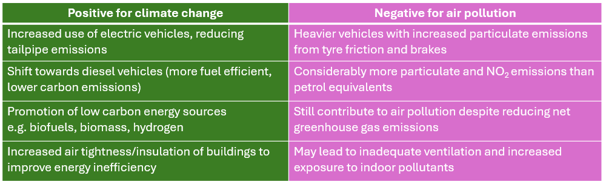
Since the primary drivers of air pollution are also the leading causes of climate change tackling both together is a powerful, interconnected strategy (5) without which, there occur unintended consequences (Figure 3). Beneficial actions include clean energy and decarbonisation to achieve Net Zero, active travel to improve local air quality and boost health and improving indoor air quality by balancing energy efficiency with adequate ventilation.
Figure 3: Climate change and air pollution trade-offs.